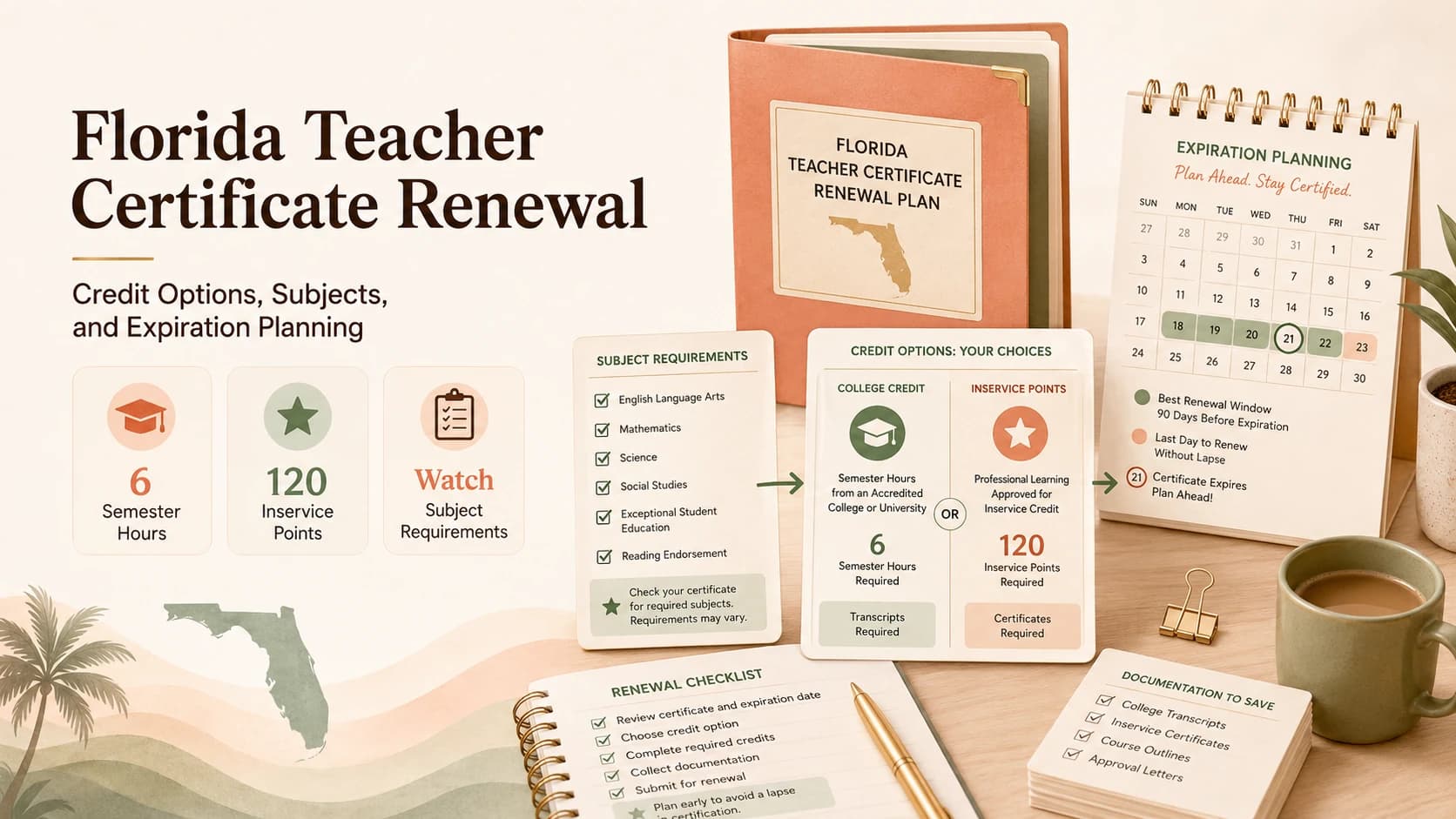
Florida renewal planning should start with the exact Professional Certificate and subject areas because renewal credit obligations can be affected by what appears on the certificate.
Choose Florida renewal credit by subject requirement, not course marketing
The state recognizes multiple ways to satisfy renewal credit, including college credit and inservice points, but the conversion and subject requirements matter more than the marketing label on a course.
District inservice records can be useful, yet a teacher who changes employers should make sure completed learning is documented in a form that can still be verified later.
Plan Florida coursework and inservice records before the final month
Waiting until the final month creates two risks at once: finding acceptable credit and allowing enough time for the application and supporting records to be processed.
An expired Florida certificate is not the same administrative problem as an active certificate approaching renewal; the first step is to identify the current status shown by the state.
College coursework should be checked for institution and credit-type acceptability before enrollment, particularly when an online provider bundles continuing education with optional graduate credit.
Build the plan around the certificate and subject areas
A renewal file should contain the certificate record, credit evidence, transcript or inservice documentation, payment confirmation, and a copy of the final renewed credential.
Florida planning should start by reading the Professional Certificate record itself. The available credit routes can include college credit and inservice points, but the subject areas on the certificate and any targeted requirements can change what a useful renewal plan looks like. That means the cheapest or fastest course is not automatically the right course. Before enrollment, identify the unit the activity will produce, who reports or documents it, and which requirement it is intended to satisfy.
The final month can combine several separate risks: finding acceptable credit, waiting for district or provider records, correcting a missing entry, and allowing the renewal transaction to process. A better file has the certificate status, subject areas, inservice or transcript evidence, and application timing visible well before expiration. Teachers who change districts should preserve evidence outside the former employer system so an otherwise valid activity does not become difficult to verify simply because an account is no longer accessible.
Florida: Credit Options, Subjects, and Expiration Planning
Florida planning should start by identifying the certificate and subject coverage, then matching renewal credit to the state’s current subject and credit rules. Keep college transcripts and inservice records distinct because they can arrive from different systems and on different timelines.
Before filing around Credit Options, Subjects, and Expiration Planning, compare the live credential record with the documents you expect the agency to rely on. Resolve any mismatch before treating payment or submission as completion.
The Florida baseline: six semester hours, including SWD
Florida's Professional Certificate renewal rule starts with six semester hours of college credit or approved equivalents earned during the validity period. At least one semester hour must address teaching students with disabilities (SWD). The six-hour total is not merely a suggestion for planning; it is the core renewal requirement for the Professional Certificate. Coursework used for renewal must be completed before the certificate expires, and a college course must generally carry a grade of C or better, with pass or satisfactory grades accepted where applicable.
Florida also recognizes approved inservice points. Twenty inservice points in an approved Florida master inservice program equal one semester hour of college credit for renewal. That means 120 qualifying inservice points could equal six semester hours, but subject-specific requirements may still control how those points are distributed.
Subject areas can change what the six hours must include
The certificate's subject coverage matters. Reading and Educational Leadership requirements cannot simply be satisfied with any random professional-development activity; Florida limits the acceptable routes for those requirements to specified college credit or inservice points. Educational Leadership certificate holders with applicable validity dates must include learning tied to Florida's educational leadership standards. Teachers should therefore list every subject on the Professional Certificate before deciding that “six credits” is the entire plan.
Florida also allows certain equivalencies. A passing Florida Subject Area Examination for the subject being renewed can equal three semester hours for renewal purposes. A valid National Board certificate can renew the Florida subject shown on that national certificate, and some National Board credentials can also address the SWD requirement in the circumstances described by the state. Those options are valuable only when they match the certificate's actual coverage.
A Florida credit-mix example
Assume an educator has already earned 60 approved inservice points during the current certificate period. Using Florida's conversion, those 60 points equal three semester hours. The educator still needs the equivalent of three more semester hours to reach six. If none of the completed points satisfy the SWD requirement, at least one semester hour or its acceptable equivalent must specifically address SWD. Buying a three-credit general education course without checking that issue could still leave the renewal incomplete.
Another teacher might use a passing subject-area exam for three semester hours and approved inservice for the remaining three. The correct combination depends on subject coverage and special requirements, so the transaction should be planned from the certificate outward rather than from whatever course happens to be cheapest.
What happens if the Florida deadline is missed?
Florida distinguishes a late renewal from reinstatement. A late-renewal application can be available after expiration only when the renewal credit requirements were completed before the certificate expired and the late application is filed within the state's allowed period. Florida currently identifies an additional $30 late fee and a deadline before July 1 of the year following expiration for that late-renewal route. If the required credit was not completed on time, the educator may be dealing with reinstatement instead.
That distinction is important because reinstatement uses its own timing and credit rules. A teacher should not assume that finishing six credits after expiration automatically converts the case into an ordinary late renewal.
Florida renewal file to assemble before submission
- Current Professional Certificate showing all subject coverages and expiration date.
- A credit ledger showing the six-semester-hour total and the SWD component.
- Official or otherwise acceptable college records for coursework and district/inservice documentation for points.
- Notes showing which requirement each reading, leadership, SWD, exam, or National Board item satisfies.
- Online renewal receipt, payment confirmation, and the renewed certificate after issuance.
Keep these records outside an employer-only account when possible. A district change late in the cycle should not turn otherwise valid renewal evidence into an access problem.