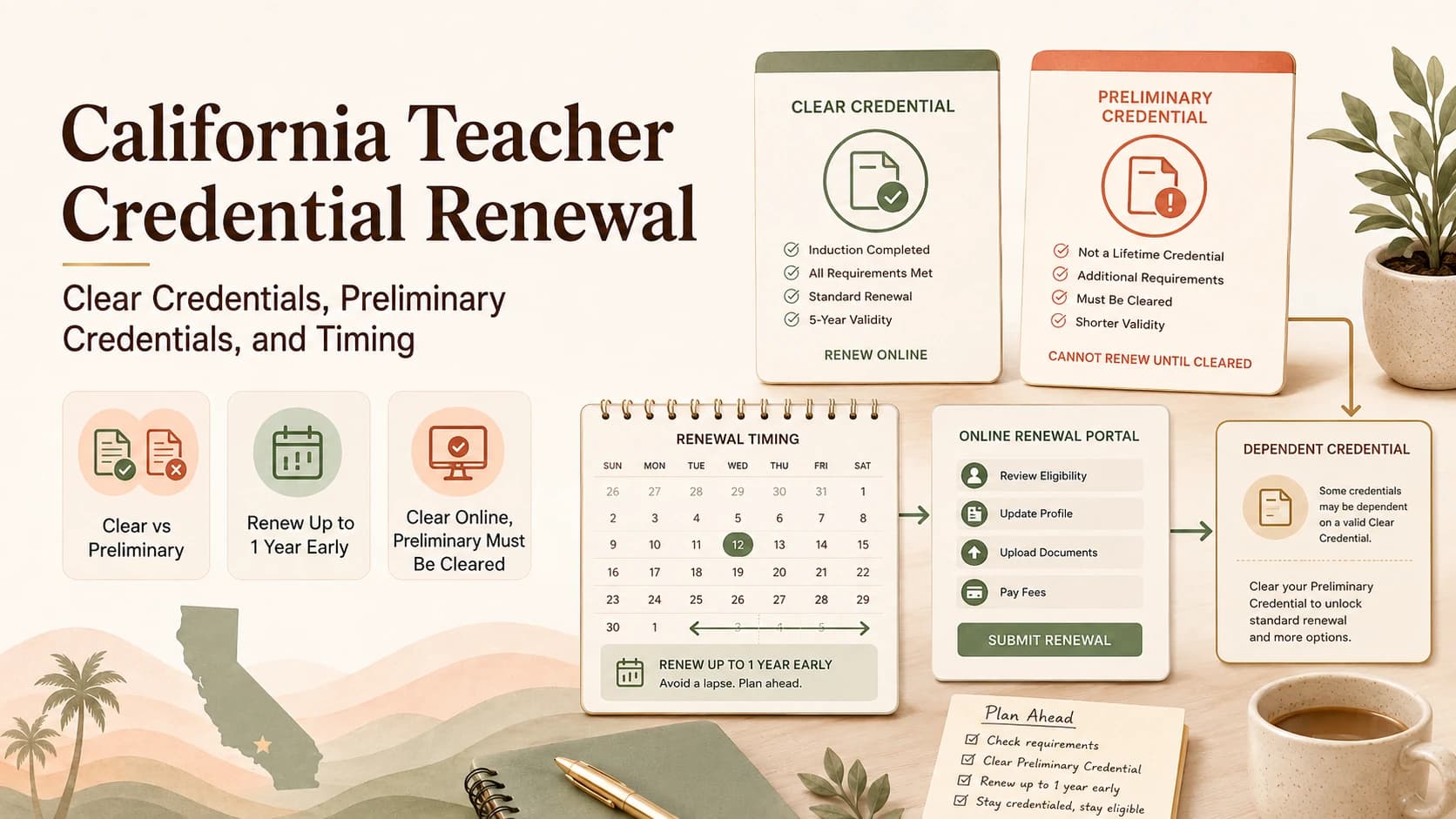
California renewal begins with the document type: clear credentials are generally renewable online, while preliminary or Level I credentials are not simply renewed and usually must be cleared.
Renewable Clear credentials follow a different path from Preliminary credentials
A renewable document may generally be renewed up to one year before expiration once its renewal requirements are satisfied; CTC says online renewals are typically processed within about ten business days unless additional review is needed.
Clear teaching and services credentials can be renewed without a blanket continuing-coursework requirement, which makes California very different from states that require a fixed number of CE hours every cycle.
Dependent credentials are tied to a base credential, so renewing one document without the prerequisite can shorten or delay the dependent document.
Renewal and clearing are different California tasks
Educators holding emergency, limited, child-development, life, or older credential types need document-specific instructions instead of assuming the clear-credential workflow applies.
A practical renewal check includes the credential title, renewal code, base-document relationship, current legal name, email address, and whether an employer must participate in the application.
California becomes confusing when the word “renewal” is applied to every credential document. A clear credential can generally follow a renewal workflow, while a preliminary or Level I document is usually a pathway that must be cleared rather than simply extended in the same way. That distinction should be made before collecting coursework, paying a fee, or assuming an online renewal button will appear. Educators with dependent, emergency, limited, child-development, life, or older documents should also read the instructions for that exact document instead of borrowing the clear-credential process.
Use timing as a verification window
A renewable California document may be eligible for online renewal before its expiration date, which creates time to correct profile or document problems. Use that window to check the credential title, prerequisites for dependent documents, and the resulting expiration date after processing. California is also a good example of why a fixed continuing-education total should not be invented where the state does not impose one across all clear credentials. The administrative goal is to renew the correct document, not to accumulate hours merely because other states use hour-based systems.
Preliminary credential holders should treat the expiration date as a clearing deadline; an extension by appeal can exist in limited circumstances but is not a routine substitute for completing induction or other requirements.
California Clear and Preliminary credentials have different end-of-term outcomes
CTC raised the processing fee for clear credential renewal/reissuance to $125 effective July 1, 2026, so old blog posts showing a lower fee may now be stale.
California: Clear Credentials, Preliminary Credentials, and Timing
California is a strong example of why the document type must be identified before searching for a continuing-education number. Clear credentials and preliminary credentials follow different pathways, and a preliminary document is generally a clearing problem rather than a routine online renewal problem.
When reviewing Clear Credentials, Preliminary Credentials, and Timing, separate the requirement itself from reporting and processing. In California, a finished step that is still missing from the CTC record calls for follow-up on posting or processing; an unmet credential condition calls for a different remedy.
Confirm the California credential type and new validity dates after processing
After the application or local request is submitted, compare the live credential or employment record with the result you expected; for Clear Credentials, Preliminary Credentials, and Timing, and keep the file open if the two do not agree.
California's first question is not “How many PD hours?”
California uses a two-tier credential structure for many teachers, and the difference between a Preliminary and a Clear credential controls the renewal strategy. A Preliminary credential is typically issued for five years but is not simply renewed every five years like a Clear credential. The holder must complete the requirements that lead to the Clear credential. Those requirements can include an induction pathway or specific renewal requirements printed on the credential record. A teacher who waits until the Preliminary expiration date and searches only for “renewal credits” may be solving the wrong problem.
A Clear credential is different. Current Commission guidance describes it as a five-year renewable credential that can be renewed online without an additional professional-development-hour requirement simply for the renewal itself. That makes California unusual compared with states that require a fixed number of PD hours each cycle.
Read the credential document before buying anything
The safest California workflow starts in the Commission on Teacher Credentialing account. Identify the exact document title, issue date, expiration date, and any renewal codes or requirements listed on the credential. If the document is Preliminary, determine what must be completed to clear it. If it is Clear, confirm that it is eligible for online renewal and that no separate condition applies to a different credential held in the same account.
This is especially important for educators who entered through an out-of-state or alternative pathway. Two teachers with similar classroom assignments can have different credential conditions because the Commission evaluated different preparation records when the Preliminary credential was issued. A generic “California teacher renewal course” cannot replace the requirements printed on the actual document.
Clear renewal versus clearing a Preliminary credential
For a Clear credential holder, the task is mainly administrative: renew the eligible document in the CTC system, pay the current fee, and verify that the new expiration date posts correctly. For a Preliminary holder, the task is an advancement or clearing process. That may involve completing an approved induction program, meeting a specific assessment or coursework requirement, or qualifying through another Commission-approved route. Those two paths should never be merged in a single checklist.
As a practical example, a teacher with a Clear Multiple Subject credential expiring in eight months generally does not need to purchase six credits merely because another state uses that model. A teacher with a Preliminary Multiple Subject credential expiring in eight months needs to inspect the renewal requirements and confirm the appropriate clearing route immediately.
Timing problems that create California delays
Teachers often create avoidable pressure by treating the expiration date as the day to begin. A better approach is to verify the credential record six to twelve months ahead, particularly for a Preliminary credential where an induction program, institution recommendation, or other third party may be involved. Names, email addresses, and account access should also be corrected before the final submission window. If an employing district or preparation program must recommend the educator, leave time for that action to occur and to be reflected in the Commission system.
After an online transaction, keep the confirmation and return to the public credential lookup or educator account to make sure the renewed or cleared document appears as expected. A receipt proves that a transaction was submitted; it does not by itself prove the new credential was issued.
California decision checklist
- Identify whether the document is Preliminary, Clear, or another credential type.
- For Preliminary credentials, follow the specific clearing requirements rather than searching for generic renewal hours.
- For Clear credentials, verify online-renewal eligibility and the current Commission fee before filing.
- Resolve account-name or email problems before the application window becomes urgent.
- Save the transaction receipt and verify the new credential and expiration date after processing.