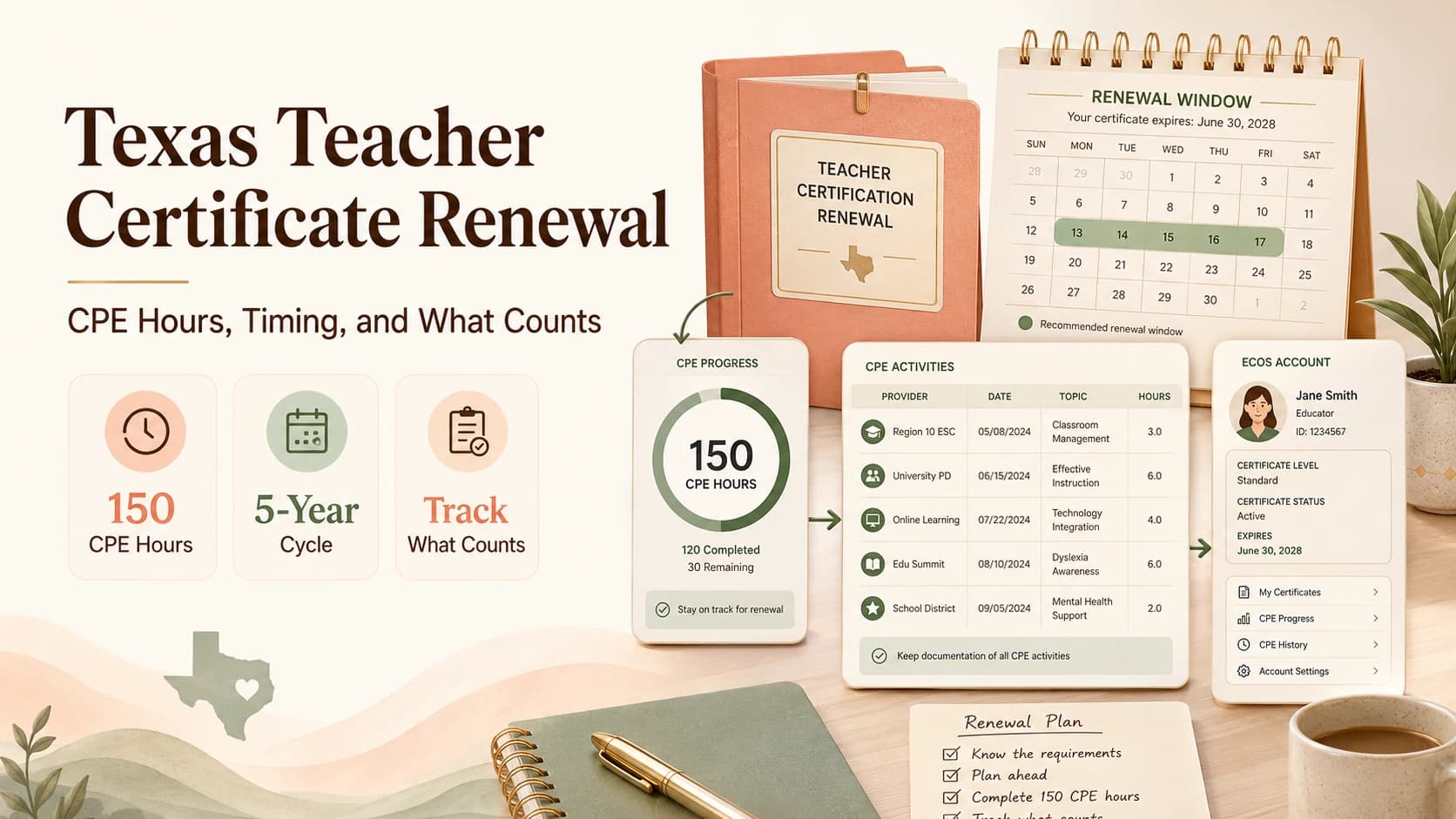
Standard classroom teacher certificates commonly use a five-year renewal cycle and 150 CPE hours; some other certificate classes use different totals, so the certificate record controls.
Build the Texas CPE file around the certificate role shown in ECOS
Texas educators renew through the state certification system and should compare the certificate expiration date with the renewal window rather than relying on a district reminder.
CPE can come from several sources, but the activity must fit TEA rules and the educator should retain provider, date, topic, and hour documentation.
A teacher who changes districts should keep an independent CPE file because district learning records do not always travel cleanly with the employee.
Texas CPE planning changes when the certificate role changes
Late renewal and inactive certificate questions need to be handled as status problems first; buying more coursework before checking certificate status can waste money.
Administrators and other credential holders may face a different CPE total than classroom teachers, so this page separates the common teacher path from certificate-specific exceptions.
Do not turn the 150-hour figure into a universal Texas rule
The common classroom-teacher pathway is useful for planning, but the certificate record still comes first because other Texas certificate classes can use different continuing-professional-education totals. A good renewal file therefore names the exact certificate before it totals hours. That prevents a teacher from copying a colleague’s checklist, discovering a different credential class late, and then trying to solve a status issue with extra coursework. The same discipline applies to late or inactive situations: first identify what TEA currently shows, then read the instructions for that status before deciding what action is missing.
Texas educators often accumulate learning through districts, conferences, universities, and other providers. The practical risk is not only whether an activity can count, but whether the educator can still prove the provider, date, topic, and hours after changing employers. Keep an independent record that can be reconciled with the state account. Before filing, compare the expiration date, CPE total, certificate class, and any unresolved provider question in one pass; after filing, keep the transaction confirmation and verify the updated certificate rather than treating payment as the finish line.
Texas: CPE Hours, Timing, and What Counts
Texas is an hour-based renewal system for common classroom-teacher Standard Certificates, so the useful planning artifact is a running CPE total tied to certificates that identify provider, date, topic, and hours. The credential class still matters because other certificate roles can use a different total.
Put CPE Hours, Timing, and What Counts into a one-page state checklist with the current credential record, the evidence for each requirement, and the date the agency must receive or process the action.
Use the Texas certificate role to set the CPE target before counting hours
Texas educators should begin with the certificate role shown in ECOS because the CPE total is not identical for every standard certificate. Build the ledger against the correct target, then record semester-credit conversions, allowed activity types, and any capped categories under the current TEA guidance. Keep completion records for the required retention period instead of sending every certificate with the application unless requested. After filing, return to ECOS and verify that the renewed certificate and new expiration date are visible. A payment receipt confirms a transaction; the issued credential is the final status the teacher needs to see.
Verify the renewed Texas certificate in ECOS before closing the cycle
After submitting the renewal transaction, return to ECOS and confirm the standard certificate shows the expected new expiration date and certificate areas. Keep the CPE ledger and supporting records for the retention period required by TEA, even if the application did not ask for every certificate at filing. If payment succeeded but the credential did not update, review the transaction status and contact TEA as appropriate before assuming the renewal is complete. The final artifact for the teacher is the renewed certificate record, not merely the payment confirmation.
Texas renewal numbers that belong in the plan
A Texas standard certificate is generally renewed on a five-year cycle. The CPE target depends on the certificate role: a classroom teacher needs 150 CPE hours, while principals, superintendents, counselors, librarians, educational diagnosticians, and reading specialists need 200 hours. Educators holding multiple standard certificates in classroom, administrator, or student-services categories renew them together and follow the 200-hour total rather than stacking a separate requirement for every certificate. The hours must be related to the certificate or certificates being renewed and completed during the active renewal period.
College coursework can be part of the total. TEA currently treats one semester credit hour as 15 CPE hours, so a three-credit graduate course can represent 45 CPE hours if it is otherwise acceptable. That conversion is useful for planning, but it should not be used to assume that any graduate course automatically qualifies. The subject matter, provider, timing, and documentation still matter.
What Texas accepts — and where the caps matter
Texas allows more than workshops. Approved-provider conferences, online courses, college coursework, in-service training, curriculum development, independent study, presenting professional learning, and mentoring can all contribute in the right circumstances. Some categories have limits. Independent study may not exceed 20 percent of a classroom teacher's 150-hour requirement, presenting or teaching CPE is capped at 10 percent, and mentoring another educator is capped at 30 percent. These limits are easy to miss when a teacher builds a five-year record from informal professional activities instead of conventional courses.
All educators also need CPE addressing students with disabilities, including dyslexia. Role-specific content can add other obligations. A superintendent, for example, has a recurring requirement related to identifying and reporting child abuse, trafficking, and maltreatment. The practical lesson is to review the certificate type before choosing the final activities rather than simply asking whether the total number of hours has been reached.
A worked Texas example
Suppose a classroom teacher begins the final year of the cycle with 112 documented CPE hours. A three-semester-credit graduate course that is relevant to the certificate could add 45 CPE hours, taking the record to 157. That may clear the numerical requirement, but the teacher should still check whether the record includes the required disability and dyslexia content and whether every activity came from an acceptable provider. The teacher should not buy another course merely because one district transcript has not yet been reconciled with the personal CPE file.
A different situation applies to a teacher who also holds a principal certificate. That educator should plan against the 200-hour total. Treating the principal credential as if the classroom-teacher 150-hour requirement were enough could leave a 50-hour gap at renewal.
ECOS, late renewal, and records after the application
TEA sends a reminder about six months before expiration to the email on the educator account, but the educator remains responsible even if the message is missed. Renewal is handled through TEAL/ECOS. TEA also instructs educators to retain supporting CPE documentation for five years because records may be requested in an audit. Certificates of completion, attendance records, transcripts, and provider documentation should therefore remain available after the renewal transaction disappears from the task list.
If a Texas standard certificate is not renewed on time, it becomes inactive. TEA says the educator can still renew after completing the CPE requirement and paying the applicable late fee; retaking certification exams is not automatically required merely because the certificate expired. Employment consequences are a separate matter, so an educator approaching expiration should involve the district certification office before relying on a late-renewal path.
Texas renewal checklist for the final six months
- Confirm every standard certificate visible in ECOS and the common expiration date.
- Use 150 hours for classroom-teacher-only renewal or 200 hours when the certificate mix triggers the higher total.
- Check required disability/dyslexia content and any role-specific training before counting the file complete.
- Convert college credit correctly: one semester credit equals 15 CPE hours.
- Preserve certificates, transcripts, attendance records, and provider evidence for the audit window.
- Submit the renewal in ECOS, save the payment receipt, and return later to verify the renewed credential rather than treating payment as the final result.